/ 03 — Autonomous Infrastructure

Systems that keep autonomous assets in operation.

Physical and digital systems that keep autonomous assets available, supportable, and mission-ready: recovery, protection, power, payload handling, inspection, and redeployment.

UAV Recovery · Illustrative Configuration
/ Why Infrastructure

It takes more than a vehicle to make an autonomous operation.

A vehicle alone: autonomy stops at the vehicle

  • Manual recovery
  • Manual charging & fueling
  • Manual inspection
  • Manual payload exchange
  • Manual maintenance
  • Manual redeployment

With Asgard infrastructure: autonomy extends to the operation

  • Robotic recovery & protection
  • Automated charging & servicing
  • Automated inspection
  • Payload & battery exchange
  • Digital coordination & data transfer
  • Remote, persistent operations
/ Infrastructure Categories

Five operating environments. One architecture.

Autonomous infrastructure is the physical and digital operating environment that lets vehicles and distributed assets work with reduced local human intervention: storing, protecting, launching, recovering, powering, servicing, and coordinating them.

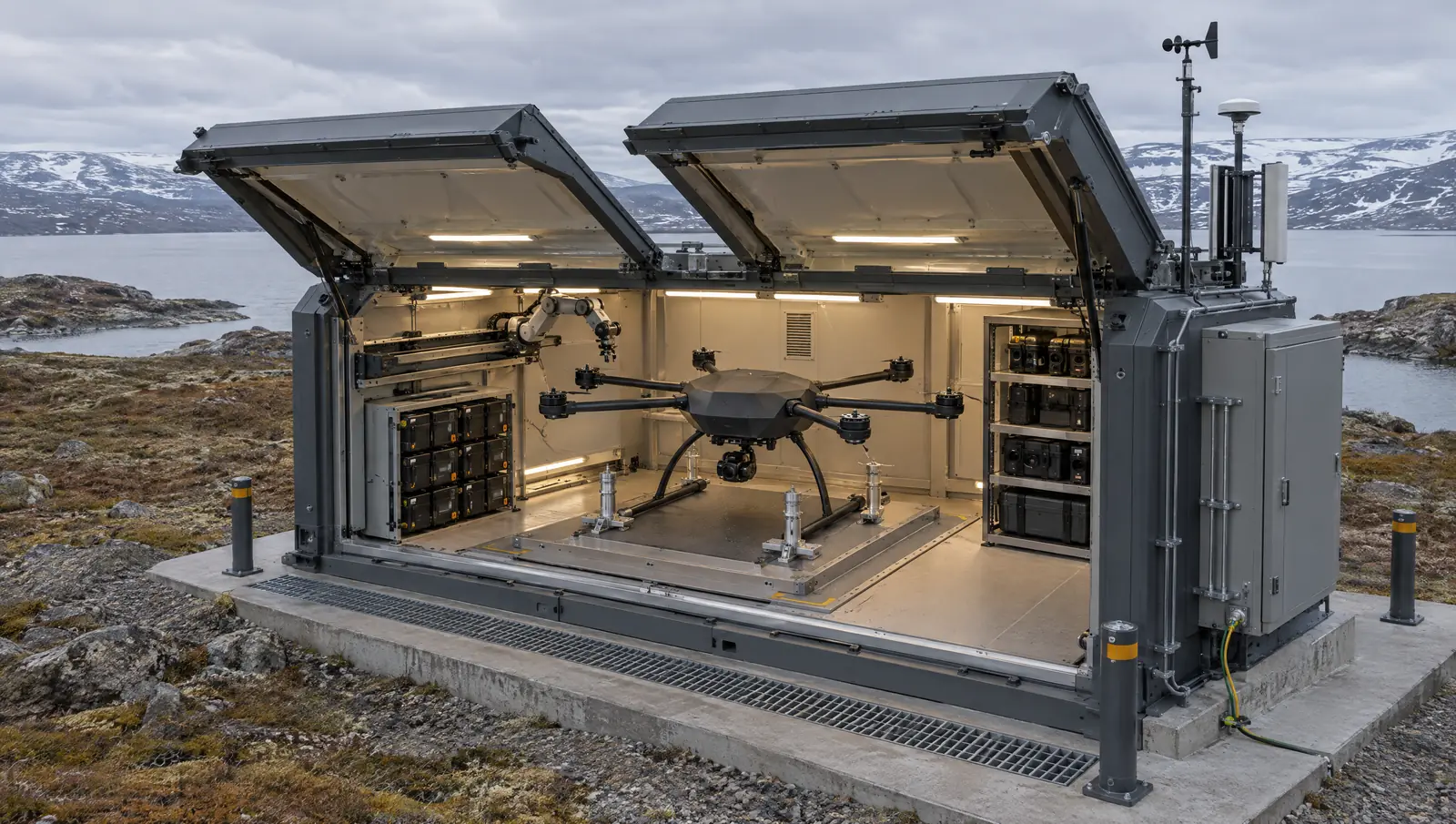
Modular robotic UAV hangar at a remote lakeside site with its clamshell roof open, a hexacopter held by centering pushers on the landing plate, a rail-mounted servicing arm, battery and payload racks, a weather mast, and an electrical cabinetIllustrative Configuration
/ 01 · Air Infrastructure

Recover, protect, recharge, relaunch.

Robotic hangars and landing platforms where an aircraft lands, is centered, charged or given a fresh battery, has its payload exchanged, and is protected from weather until its next sortie.

  • Robotic UAV Hangars
  • Landing Platforms
  • Battery Exchange
  • Payload Exchange
  • Remote Operating Stations
Illustrative Configuration · USV capture
/ 02 · Maritime Infrastructure

Docking and capture, built for salt water.

Robotic USV hangars and pier-integrated docks with mechanical capture, shore power, payload handling, and corrosion-resistant structure, so a vessel can arrive, be secured, and be serviced without a crew on the pier.

  • Robotic USV Hangars
  • Docking Stations
  • Recovery Systems
  • Charging + Fueling
  • Payload Handling
Six-wheeled uncrewed ground vehicle parked on alignment rails in a robotic garage, with an overhead automated charging connector engaged and a robotic manipulator beside a battery exchange rackIllustrative Configuration
/ 03 · Land Infrastructure

Garages and shelters for ground robots.

UGV garages and robotic shelters where a ground vehicle aligns, connects to automated charging, exchanges batteries, tools, or payloads, and is inspected before it returns to work.

  • UGV Garages
  • Robotic Shelters
  • Charging + Refueling
  • Tool Exchange
  • Maintenance Cells
High-bay payload processing facility with a small satellite on a precision rotation fixture under an overhead crane, softwall clean enclosure, test support rack, and open transport container, with two technicians in cleanroom garmentsIllustrative Configuration
/ 04 · Space-Support Infrastructure

Ground systems that handle flight hardware.

Payload processing, robotic handling, integration fixtures, clean enclosures, transportation, and test support: the ground infrastructure that moves spacecraft hardware safely from integration to the launch site.

  • Payload Processing
  • Robotic Handling
  • Integration Fixtures
  • Clean Enclosures
  • Ground Support Equipment
Expeditionary mission-support node on open grassland with equipment shelters, a communications mast and satellite terminal, trailer-mounted energy storage with solar array, a compact UAV hangar, a UGV on a charging pad, and a sensor towerIllustrative Configuration
/ 05 · Distributed Mission Infrastructure

Operating capacity, wherever the mission is.

Networked, field-deployable nodes combining communications relays, energy systems, remote sensing, fleet support, and remote operations, so distributed assets stay supported far from a fixed base.

  • Fleet Support Nodes
  • Communications Relays
  • Energy Systems
  • Remote Sensor Stations
  • Mobile Command
/ Product Families

What Asgard is building.

Eleven families of autonomous infrastructure, developed on one common system architecture and executed through one industrial model. These are design concepts in development; none is presented as a fielded product.

Inside a UAV hangar module: a rail-mounted robotic arm withdraws the battery cassette from a hexacopter held on its landing plate, beside a slotted battery storage rack Illustrative Configuration
01 / Product Family

UAV Hangar Platform

Robotic infrastructure for aircraft protection, recovery, charging, payload handling, inspection, data transfer, and mission turnaround.

Enclosed USV hangar over the water with its door raised and a vessel resting on a submerged lift cradle beneath an overhead handling gantry and shore-power reel Illustrative Configuration
02 / Product Family

USV Hangar Platform

Autonomous maritime infrastructure for docking, protection, charging or fueling, payload operations, inspection, maintenance support, and redeployment.

Tracked uncrewed ground vehicle chocked on a service deck while a gray industrial manipulator inside a marked safety zone lifts a battery module from its side bay Illustrative Configuration
03 / Product Family

UGV Support Station

Infrastructure for robotic ground systems including charging, battery exchange, tool exchange, payload exchange, inspection, maintenance, and fleet support.

Containerized mobile support node at dusk with its roof hatch open as a hexacopter lands, a telescoping antenna mast, an open equipment door, solar panels, and a generator module Illustrative Configuration
04 / Product Family

Mobile Autonomous Support Node

Deployable infrastructure supporting autonomous assets in expeditionary, remote, or distributed operating environments.

Aerial view of a launch and recovery range: a trailer-mounted rail launcher aimed down a marked launch corridor, and a separate guyed two-mast recovery net about 150 m away with its own marked approach lane at right angles to the launch direction Illustrative Configuration
05 / Product Family

Launch and Recovery Platform

Integrated equipment for controlled vehicle deployment, positioning, capture, recovery, and servicing.

Modules + platforms · 06 to 11

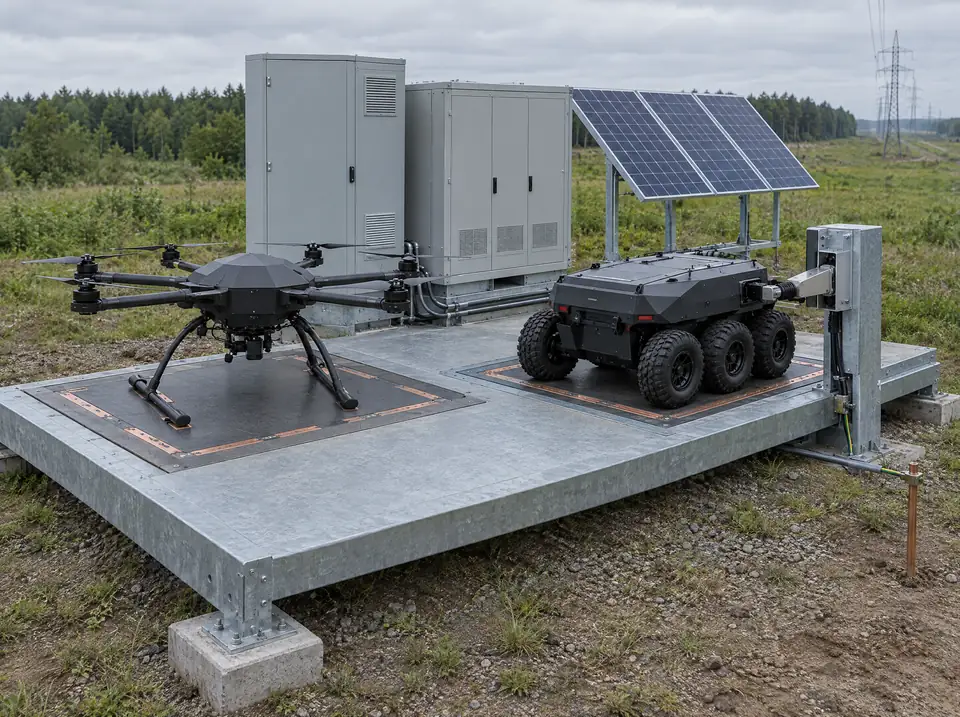
Galvanized charging skid with a hexacopter on a contact-charging pad and a six-wheeled UGV docked to an automated charging connector, fed by power cabinets and a solar array
06 / Product Family

Distributed Charging Platform

Conductive or inductive charging with automated connector engagement, battery health and thermal monitoring, and charge scheduling for mixed fleets.

Robotic arm holding a gimbal camera payload under a quadcopter's quick-release payload rail, beside a rack of alternate payload modules
07 / Product Family

Robotic Payload Exchange Platform

Robotic removal and installation of sensor and mission payloads with mechanical locking, electrical and data connection, functional verification, and configuration control.

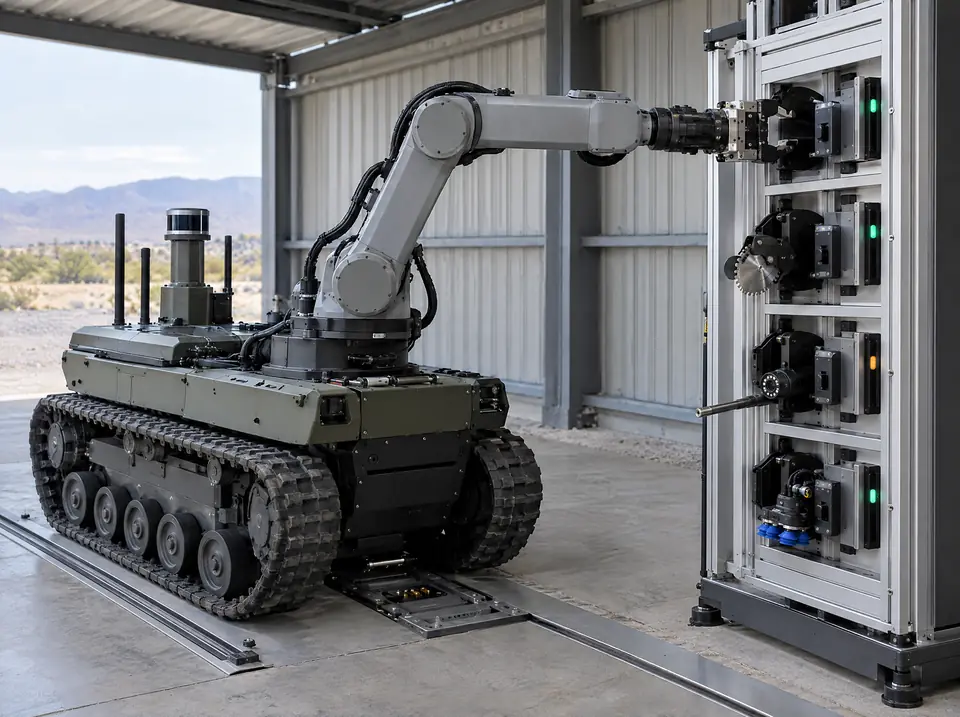
Tracked UGV with a manipulator arm docking its wrist tool-changer into a rack of holstered end effectors: gripper, cutting tool, inspection probe, and vacuum gripper
08 / Product Family

Robotic Tool Exchange Platform

Tool identification, storage, and positioning for robotic pickup and release, with utility connection, tool verification, and calibration status tracking.

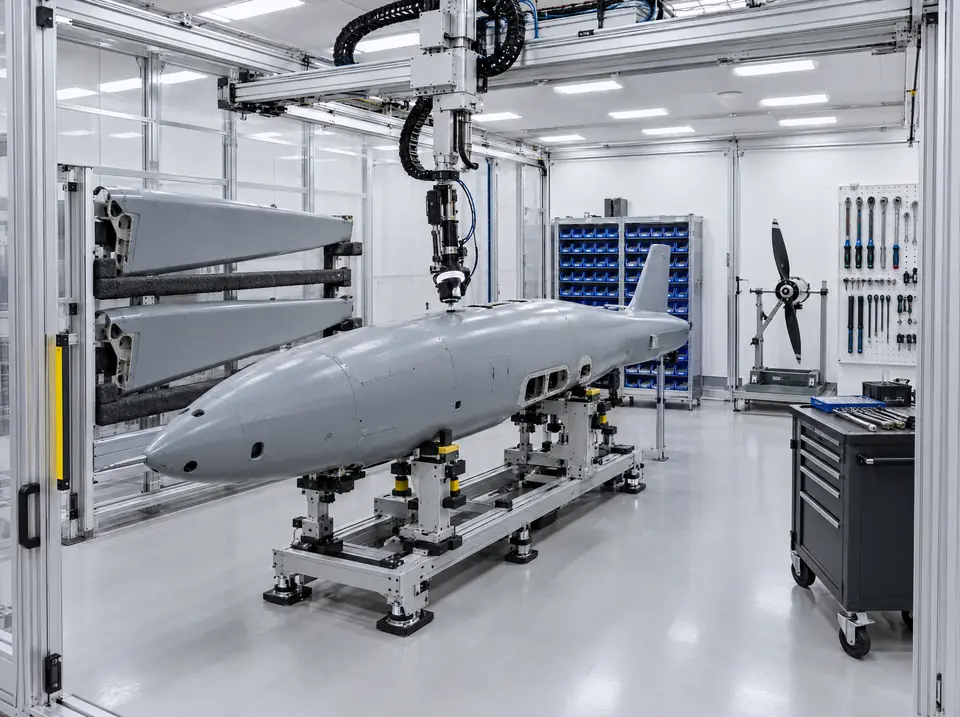
Enclosed maintenance cell with an uncrewed aircraft fuselage on an adjustable cradle, a gantry-mounted inspection probe over the skin, wings on a padded rack, and a propeller on a balancing stand
09 / Product Family

Autonomous Maintenance Cell

Inspection, diagnostics, cleaning, module and sensor replacement, and minor repair, with each maintenance action traceable to the asset it was performed on.

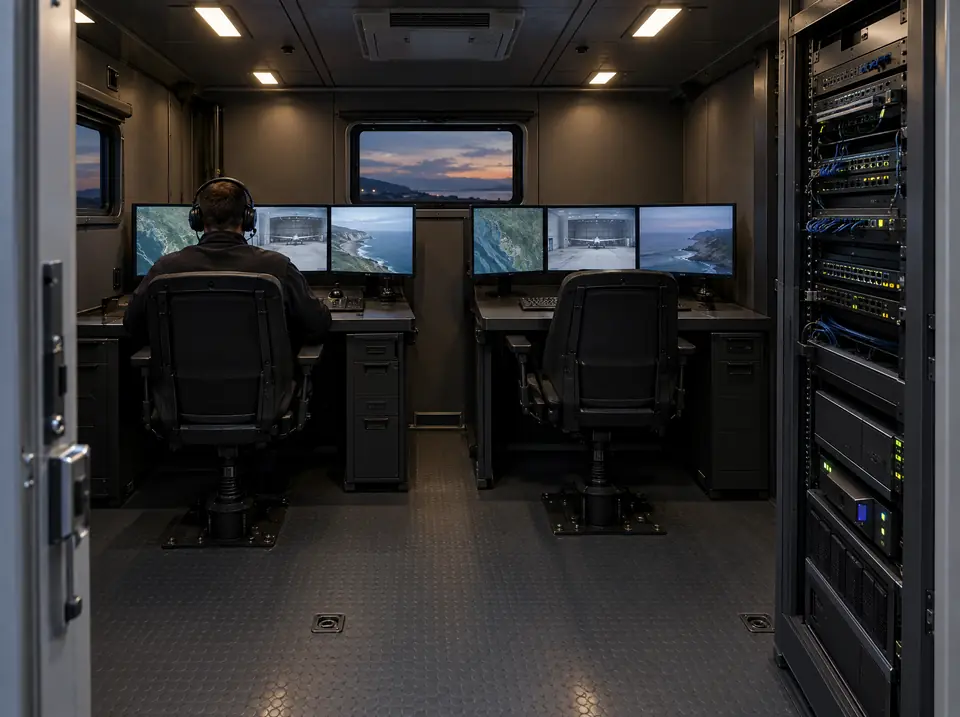
Interior of a ruggedized mission command shelter with two remote-operator workstations, an operator wearing a headset, and an equipment rack of network hardware
10 / Product Family

Mission Command Shelter

Ruggedized shelters for remote operators to supervise fleets, monitor readiness, and coordinate distributed autonomous assets from the field.

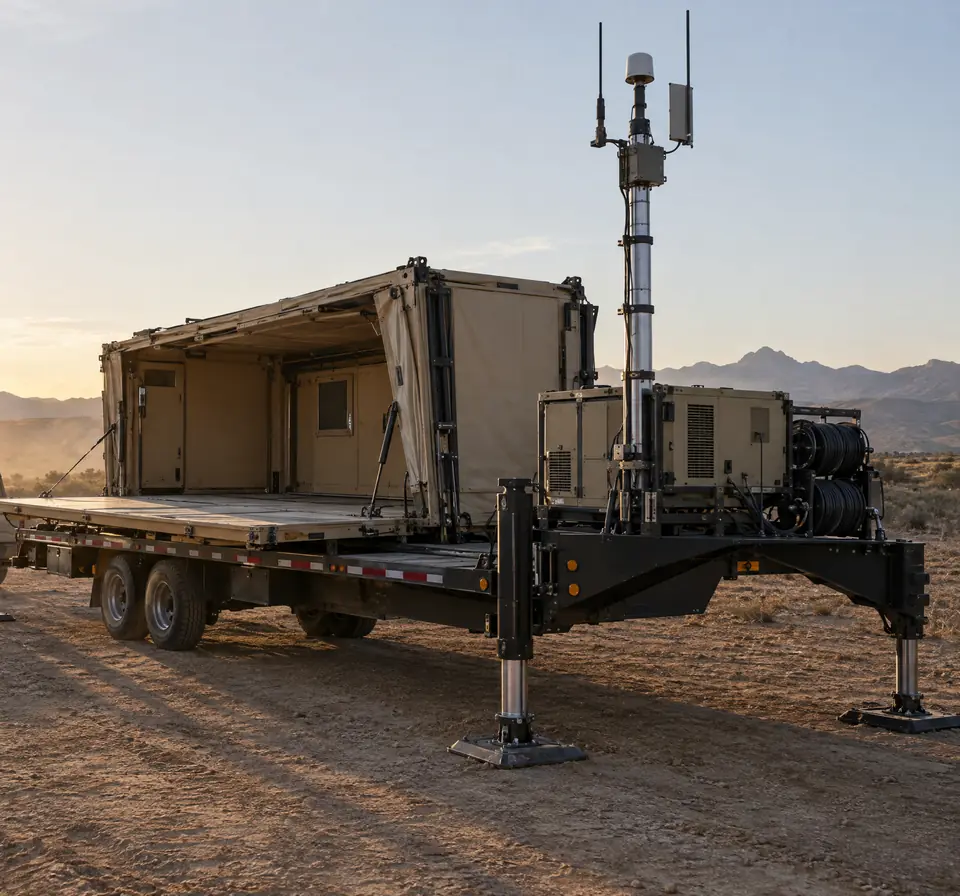
Trailer-mounted expeditionary platform deploying at dawn: a folding shelter opening into a deck, leveling jacks on footpads, and a telescoping communications mast rising
11 / Product Family

Expeditionary Infrastructure Platform

Trailer-mounted and containerized infrastructure that deploys, levels, powers up, and establishes communications at a new site, then packs down to move.

System imagery shows illustrative design concepts · systems are in development, not fielded

/ The Operational Cycle

Every system serves the same loop.

Whatever the vehicle and wherever the mission, infrastructure exists to close one loop, and keep closing it autonomously.

Arrive→ Recover→ Service→ Reconfigure→ Verify→ Return to Mission
/ Engage

Operating autonomous assets?

Forging Brilliance, Destined by Design.